
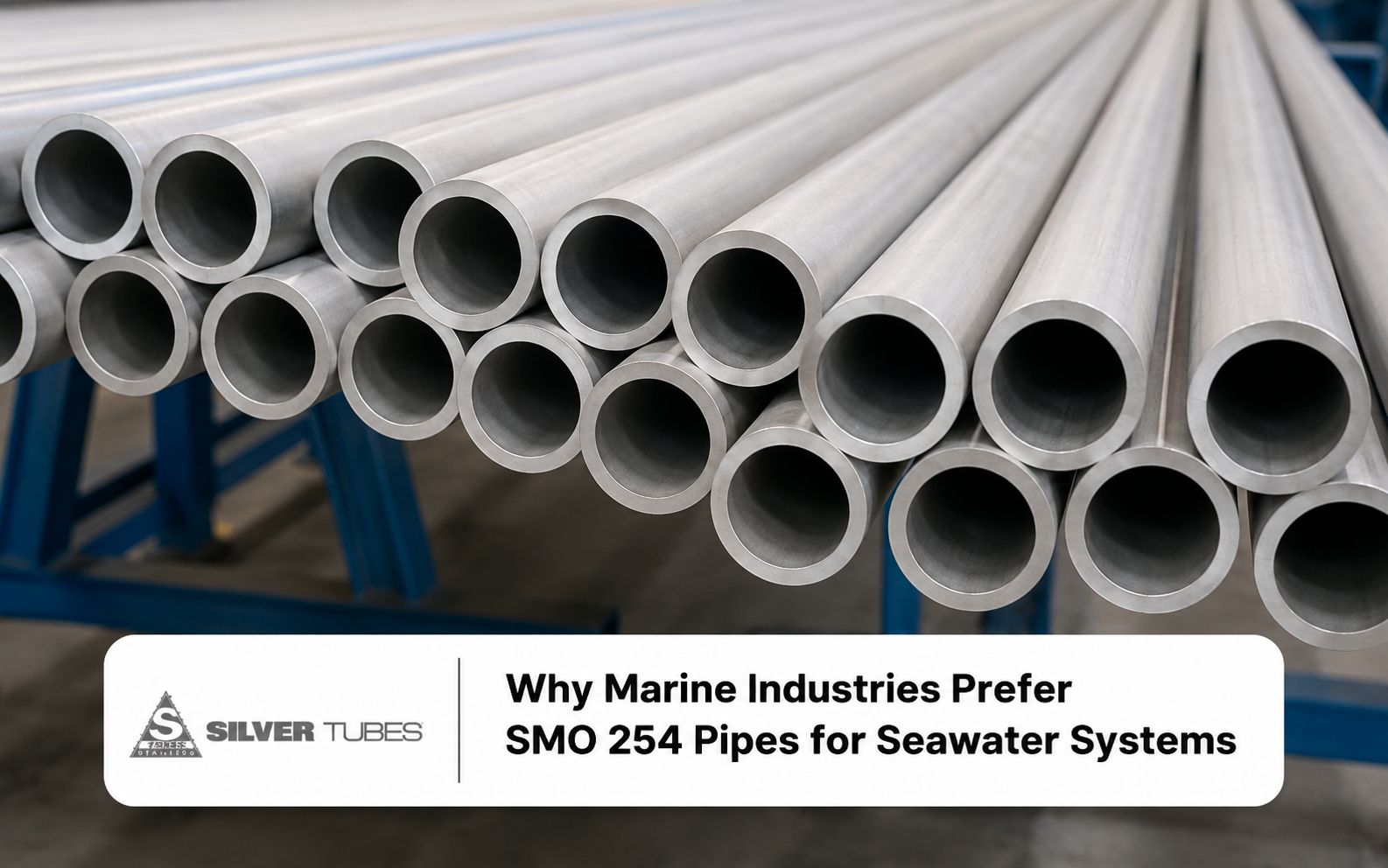
Seawater is highly corrosive to conventional stainless steel, as chlorides gradually break down its protective oxide layer, causing pitting, crevice corrosion, and premature failure. In offshore, marine, and desalination applications, this can lead to costly repairs and unexpected damage. The SMO 254 pipes are designed to withstand these harsh conditions. This super austenitic stainless steel offers exceptional resistance to chloride-induced corrosion, excellent mechanical strength, and a long service life, making it an ideal option for demanding seawater and marine piping systems.
What Are SMO 254 Pipes?
SMO 254, also known as UNS S31254 or Werkstoff 1.4547, is a super austenitic stainless steel with roughly 20% chromium, 18% nickel, 6% molybdenum, and controlled nitrogen. That composition pushes its pitting resistance number well above 316L. The alloy falls under ASTM A312, ASME SA312, A409, and A358 specs, shipping as seamless or welded pipe from 1/2″ NB to 24″ NB, with outer diameters from 21.3 mm to 1219 mm.
Key Characteristics of SMO 254 Pipes
The four key properties explain why this grade holds up where common stainless fails.
High molybdenum and nitrogen content: At 6% molybdenum and 0.18 to 0.22% nitrogen, the alloy resists chloride attack better than 316L.
Excellent corrosion resistance: Deceleration of pitting, crevice attack, and general corrosion, even in stagnant areas where deposits accumulate.
High mechanical strength: Tensile strength is around 650 MPa minimum and 300 MPa yield point, enabling thinner walls.
Good weldability: The alloy welds using conventional processes without heavy pre-treatment, though heat input control matters near the weld zone.
Why Seawater Systems Require High-Performance Pipe Materials
Continuous immersion is not comparable to intermittent exposure. Chloride ions break down the passive film on standard stainless, and once that film fails, localised corrosion accelerates fast. Biofouling adds stress too, as marine organisms create oxygen-depleted pockets that trigger crevice attack. A pipe that performs fine in freshwater can fail within months in seawater.
Common Corrosion Risks in Marine Environments
Several failure modes recur across offshore and coastal piping.
Pitting corrosion starts at surface defects, where chlorides concentrate and eat through metal in small, deep holes.
The crevice corrosion develops under gaskets and deposits, where oxygen cannot reach, and local chemistry turns acidic.
Stress corrosion cracking appears when tensile stress combines with chloride exposure, producing cracks that go unnoticed until a line ruptures.
Biofouling-related degradation happens as marine growth shields the metal beneath it, creating the same low-oxygen conditions that drive crevice attack.
Why Marine Industries Prefer SMO 254 Pipes
SMO 254 holds a clear edge over standard grades in aggressive marine service. Four factors drive that preference on real projects.
Exceptional Resistance to Chloride-Induced Corrosion
The molybdenum and nitrogen combination raises the pitting resistance number well past 316L, so chloride-heavy seawater no longer dictates a short life.
Superior Performance in Seawater Exposure
Full immersion, splash zones, and tidal sections stress a pipe differently. SMO 254 holds up consistently across all three.
High Strength with Long Service Life
A 650 MPa tensile minimum lets engineers specify thinner walls at equal pressure ratings, lowering weight without shortening service years.
Reduced Maintenance and Operational Downtime
Fewer pitting and cracking reduce emergency shutdowns and lower maintenance costs.
Applications of SMO 254 Pipes in Marine Seawater Systems
Several marine systems depend on this grade where failure is not an option.
Seawater Cooling Systems
Power plants and coastal facilities use SMO 254 for cooling water intake, where constant flow meets chloride exposure.
Offshore Oil and Gas Platforms
Firewater rings and utility piping run this alloy because repair access is limited and downtime is costly.
Desalination Plants
Reverse osmosis and thermal desalination lines see concentrated brine, and SMO 254 resists the elevated chloride levels this produces.
Shipbuilding and Marine Vessels
Ballast, bilge, and seawater lines on vessels use this grade, as hull penetrations leave little room for failure.
Firewater and Ballast Water Systems
These systems sit idle for long stretches, and stagnant seawater in idle piping is where standard stainless steel pits fastest.
SMO 254 Pipes vs Conventional Stainless Steel Pipes for Marine Applications
Compared against 316L and duplex grades in seawater duty, the gap shows in four areas: corrosion resistance, pressure performance, service life, and upkeep. Higher alloy content resists chloride levels that force 316L into premature pitting, while 650 MPa tensile strength supports thinner walls at equal ratings. Service life often runs several times longer, so lifecycle cost usually comes out lower despite the higher initial price.
Factors to Consider When Selecting SMO 254 Pipes for Seawater Systems
There are several factors to consider for the final specification. Operating pressure and temperature decide the pipe’s thickness. Chloride levels change by location, so test local seawater before choosing the grade. The pipe size should fit both flow needs and structural strength, not just the labelled bore size. Compliance with ASTM, ASME, and project specifications is non-negotiable on offshore contracts, and welding requirements deserve early attention, as heat input control protects the corrosion resistance the alloy was chosen for.
Best Practices for Maximizing the Performance of SMO 254 Pipes
- Getting the full service life out of this alloy depends on handling, not just the grade.
- To avoid contamination, store pipes off the ground and away from carbon steel touch prior to installation.
- Use specialist tools and grinding wheels that have never touched carbon steel, as cross-contamination adds free iron, which causes rust.
- To avoid chromium depletion at the weld zone, carefully control the weld heat input and use the appropriate shielding gas.
- Schedule routine inspections of flanges, welds, and low-flow portions, as this are where pitting usually begins.
- Long-Term Advantages of Using SMO 254 Pipes in Marine Infrastructure
- The benefits of a project compound over time rather than remaining constant.
Extended Service Life
These lines are resistant to pitting, crevice attack, and cracking; thus, they frequently outlast the design life of the surrounding structure.
Lower lifecycle costs.
Within a few years, the higher initial cost will be compensated by fewer replacements and less downtime.
Improved Operational Reliability
Cooling and utility systems built on this alloy see fewer unplanned shutdowns tied to piping failure.
Enhanced Safety and Efficiency
Firewater and ballast systems that stay corrosion-free perform when actually needed, which matters more than routine uptime.
Conclusion
Seawater punishes ordinary stainless steel, and marine projects cannot afford piping failures below the waterline. SMO 254 pipes address this through chloride resistance, high mechanical strength, and a service life standard that grades cannot match. Choosing the right pipe material at the start rather than following a corrosion failure keeps cooling systems, desalination plants, and offshore platforms in operation without costly shutdowns. For seawater duty, this alloy remains the practical choice engineers keep specifying.