
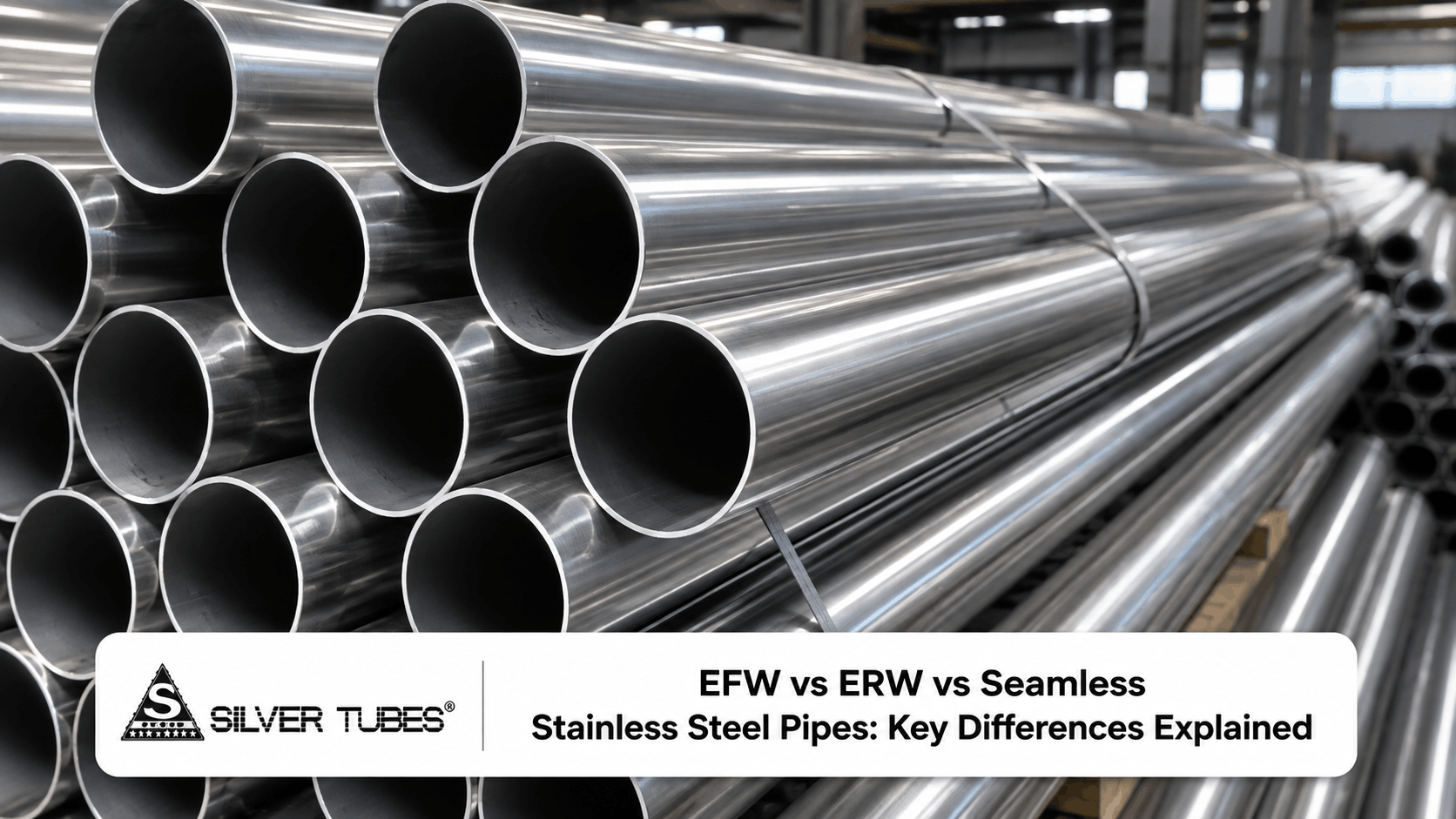
Stainless steel pipes carry corrosive fluids, high pressure steam and process chemicals through refineries and power plants without failing under stress. They are made by three methods, electric fusion welding, electric resistance welding and seamless extrusion from solid billets. Each method changes how the pipe performs, what it costs, and where it fits into a project. Each method changes how the pipe performs, what it costs, and where it fits into a project.
Buyers who confuse EFW Stainless Steel Pipes with ERW Stainless Steel Pipes frequently over-specify or under-specify material. This guide compares EFW vs ERW Pipe and seamless construction across process, performance, cost, and application, matching the right stainless steel pipe grades to the right industrial piping systems.
What Are EFW Stainless Steel Pipes?
Manufacturers form EFW Stainless Steel Pipes by rolling stainless steel plates or coils into a cylinder, then fusing the longitudinal seam with an electric arc under an inert gas shield, giving tight tolerance at large diameters. These pipes commonly range from 16 inches to 100 inches outer diameter, where seamless production is less economical. They serve power plants, water treatment, chemical plants and oil and gas after radiography and heat treatment.
What Are ERW Stainless Steel Pipes?
ERW stainless steel pipes are produced by rolling a stainless strip into a pipe, bringing the edges together and fusing them using the heat generated by electrical resistance, without the use of filler metal. This process creates a smooth, low profile weld seam and a uniform wall thickness. Sizes range from 1/2 inch to 24 inches. Fast manufacturing makes ERW the most economical choice for water, structural and industrial piping.
What Are Seamless Stainless Steel Pipes?
Seamless stainless steel pipes are produced from solid billets which are pierced and then rolled and drawn into shape without a weld seam. They have a more regular grain structure and can withstand pressure better. They are used for high pressure, high temperature service. They are frequently selected by refineries, petrochemical plants, boilers and offshore systems for demanding applications.
Comparison Table: EFW vs ERW vs Seamless Pipes
Below is a quick side-by-side look at how the three manufacturing methods stack up.
| Parameter | EFW | ERW | Seamless |
| Manufacturing Process | Fusion-welded plate/coil | Resistance-welded strip | Pierced and rolled billet |
| Weld Seam | Yes, radiographed | Yes, low-profile | None |
| Diameter Range | 16″ to 100″ | ½” to 24″ | Up to 24″ |
| Pressure Resistance | Moderate to high | Moderate | High |
| Temperature Capability | Good | Moderate | Excellent |
| Mechanical Strength | High, weld-dependent | Moderate | Highest, uniform |
| Cost | Mid-range | Lowest | Highest |
| Typical Applications | Large-bore process lines | Water and structural piping | Refineries, boilers |
Applications of EFW, ERW, and Seamless Stainless Steel Pipes
EFW Pipe Applications
- Large-scale industrial piping systems
Move fluids or gases across facilities efficiently, handling high flow rates, pressure changes, and corrosive service conditions.
- Power plants
Carry steam, cooling water, and process media through generation equipment reliably under heat, pressure, and continuous operation.
- Petrochemical facilities
Transport aggressive chemicals and high-temperature process streams safely through refining and processing units with strong corrosion resistance.
ERW Pipe Applications
- Structural and utility piping
Supports building frameworks and noncritical service lines, carrying water, air, or drains with practical strength and low cost.
- Water distribution systems
Moves clean or treated water through networks reliably, balancing flow, durability, and affordability across municipal or industrial systems.
- General industrial use
Handles routine plant fluids and utility services, offering a versatile, economical option for moderate-pressure applications.
Seamless Pipe Applications
- High pressure process systems
Transport fluids safely at high pressures with no seams so no seam failure and no worries about safe operation.
- Oil and gas exploration
High pressure resistance and reliable performance to handle tough field conditions in drilling and extraction.
- Heat exchangers and boilers
Efficiently carry high temperature media. Resist thermal stress and pressure. Provide long term durability in continuous service.
How to Choose the Right Stainless Steel Pipe Type
Choose EFW pipe for large industrial service when diameters exceed 24 inches or heavy wall sections are required. Industrial Pipe Applications such as flue gas ducting and large bore chemical transfer are well suited. Use ERW Pipe when the pressure is moderate and you want budget efficiency. Seamless pipe generally doesn’t need the extra strength for structural framing and water lines. Use seamless pipe when strength is more important than price, especially in high pressure or temperature applications.
Quick Pipe Selection Checklist
- Operating pressure
- Temperature requirements
- Pipe size
- Industry specifications
- Budget considerations
- Corrosion environment
Choosing a Reliable Stainless Steel Pipe Supplier
A trusted Stainless Steel Pipe Supplier stocks EFW, ERW and seamless together, so buyers can compare grades without changing suppliers. Certifications and full traceability are as important as the stock itself. Do not assume compliance with ASTM, ASME or any other standards. Request for test certificates, confirm in-house quality inspection, and rely on the support of stainless steel pipe grades, stainless steel fittings.
Conclusion
EFW, ERW, and seamless stainless steel pipes serve different needs. EFW suits large diameters that seamless pipes cannot produce economically. ERW is a cost effective option for moderate pressure. Seamless pipes are better in pressure and temperature, but they cost more. Before you decide on the right pipe for your application, take pressure, temperature, size and budget into consideration.