
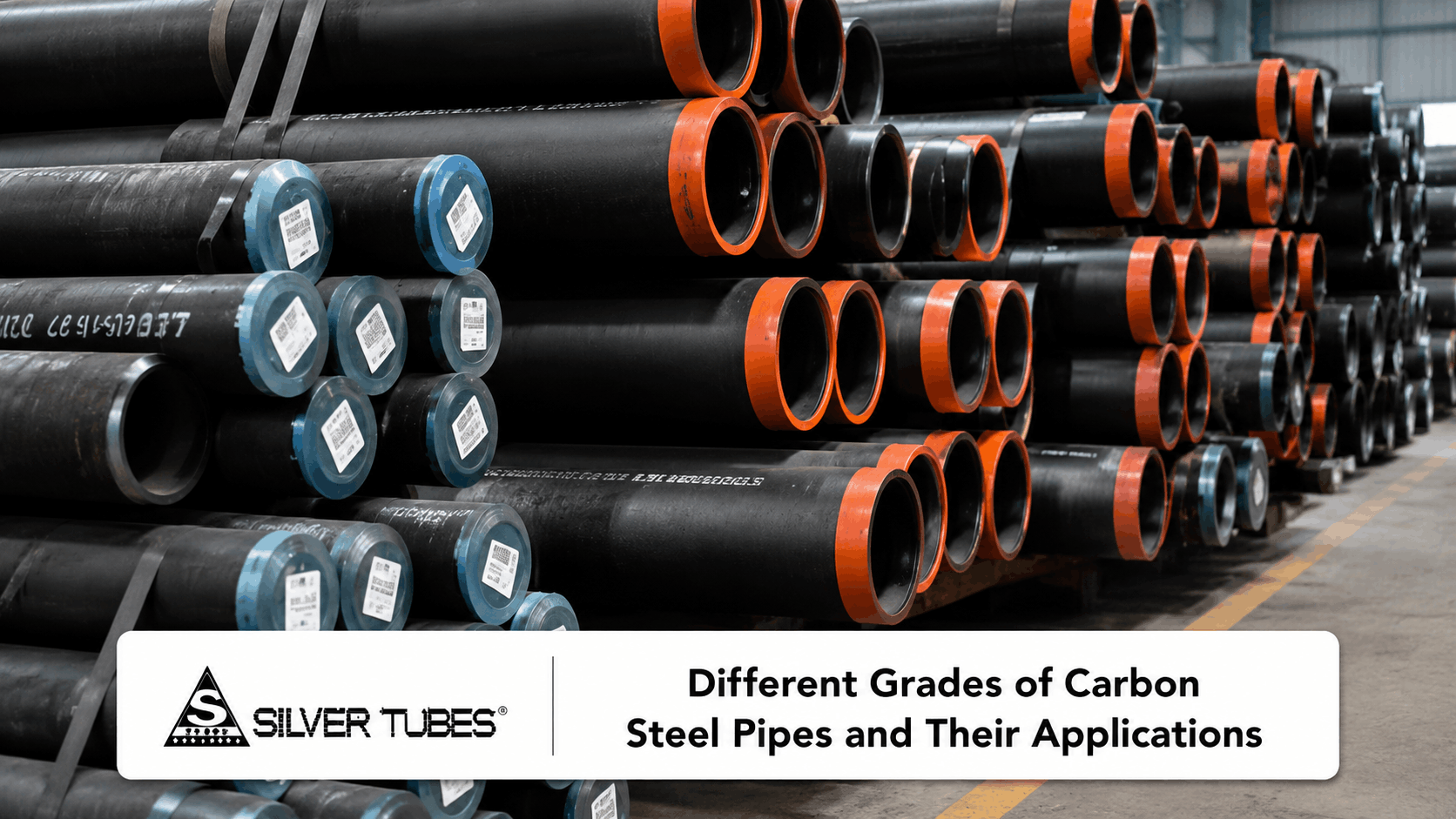
Carbon steel pipe grades prevent catastrophic delayed pipeline failures in critical industrial applications. It fails three years in, under load, when replacement costs the most. Carbon steel pipes carry oil, steam, water, and process fluids across nearly every heavy industry, and that range of duty is why no single grade fits every job. Picking the correct carbon steel pipe grade shapes performance, safety, and total cost long before the pipe goes into the ground.
What Are Carbon Steel Pipes?
Carbon steel pipes are tubular products made primarily of iron and carbon, with the carbon percentage driving hardness, strength, and ductility. Higher carbon content raises strength but cuts weldability, so grade selection always trades one property against another. The appeal is straightforward: high strength, durability, low relative cost, and weldability that makes fabrication practical. Pipes come in two forms, seamless carbon steel pipes drawn from solid billet, and welded carbon steel pipes formed from rolled plate.
Classification of Carbon Steel Pipe Grades
Low Carbon Steel Pipes
Low carbon content keeps these pipes ductile and easy to weld, suited to general piping over high-pressure service.
Medium Carbon Steel Pipes
Here, low carbon grades fail. More carbon implies more strength and hardness.
High-Carbon-Steel Pipe
More carbon means more wear resistance. But this is for specialized, abrasion-intensive applications.
Significance of industry norms
Each grade is defined in terms of chemistry, mechanical limits, and testing by ASTM, ASME, and API specifications, allowing for cross-supplier sourcing at all.
Common Carbon Steel Pipe Grades and Their Applications
ASTM A106 Pipes
Key Characteristics: Seamless construction, built for high-temperature service. Common Applications: Refineries, power plants, petrochemical facilities, process piping.
ASTM A53 Pipes
Key Characteristics: Available seamless or welded, suited to pressure and mechanical duty. Common Applications: Water pipelines, structural work, industrial utility systems.
API 5L Grade B Pipes
Key Characteristics: Built for oil and gas transport, with solid strength and weldability. Common Applications: Pipelines, energy infrastructure, natural gas distribution.
API 5L X42, X52, X56, X60 Pipes
Key Characteristics: The X-number marks minimum yield strength in ksi, so X60 yields at 60,000 psi against X42’s 42,000, higher grades for tougher operating conditions. Common Applications: Oil and gas transmission, long-distance pipeline projects, petrochemical infrastructure.
ASTM A333 Pipes
Key Characteristics: Engineered for low-temperature service without brittle failure. Common Applications: Cryogenic systems, low-temperature processing, industrial refrigeration.
ASTM A335 Alloy Steel Pipes
Key Characteristics: Alloy composition built for elevated temperature and pressure. Common Applications: Power generation, high-temperature process industries, boiler systems.
Comparison Table of Popular Carbon Steel Pipe Grades
| Standard | Pipe Type | Strength Level | Temperature Capability | Common Industries |
| ASTM A106 | Seamless | Moderate | High-temperature | Refineries, power plants |
| ASTM A53 | Seamless/Welded | Moderate | Standard | Water, structural |
| API 5L Grade B | Seamless/Welded | Moderate-high | Standard | Oil and gas pipelines |
| API 5L X42-X60 | Seamless/Welded | High | Standard | Long-distance pipelines |
| ASTM A333 | Seamless | Moderate | Low-temperature | Cryogenic systems |
| ASTM A335 | Seamless | High | High-temperature | Boilers, power generation |
Applications of Carbon Steel Pipes and Choosing the Right Supplier
Operating pressure, temperature, corrosion exposure, and applicable standards all push different industries toward different grades.
Oil & Gas Industry
Petrochemical Plants
Power Generation
Construction and Infrastructure
Water Treatment Facilities
Manufacturing Industry
Transmission pipelines, process piping, steam lines, structural frameworks, water distribution, and equipment piping each demand a grade matched to their service conditions. Whatever the application, choosing a reliable carbon steel pipe supplier matters just as much as the grade itself. Look for ASTM, API, and ASME compliance, mill test certificates, material traceability, quality inspection, technical support, and dependable delivery, since a certified grade means little if the supplier behind it can’t back it up.
Factors to Consider When Selecting a Carbon Steel Pipe Grade
Operating Temperature
Match the grade capabilities to the actual service temperature, not only the nominal pressure class.
Pressure Requirements
Choose strength levels that are stable under real, not theoretical, operating pressure.
Corrosion Environment
Aggressive media may need coatings, linings, or a different base material.
Welding and Fabrication Needs
Confirm grade is suitable for shop’s welding and forming processes before ordering.
Industry Standards and Compliance
ASTM, API, and ASME regulations are not “nice to haves”; they define what “correct” is.
Budgeting
Balance initial cost with performance, as under defining a grade usually costs more in downtime later.
Quick Pipe Selection Checklist: pipe grade, pressure rating, temperature range, corrosion protection, regulatory requirements, application type.
Conclusion
Understanding the range of carbon steel pipe grades and where each fits turns a generic material choice into one that protects performance, safety, and budget. Industry standards keep that decision reliable across suppliers and projects. Partner with a trusted carbon steel pipe supplier to source certified grades that meet your project’s requirements.