
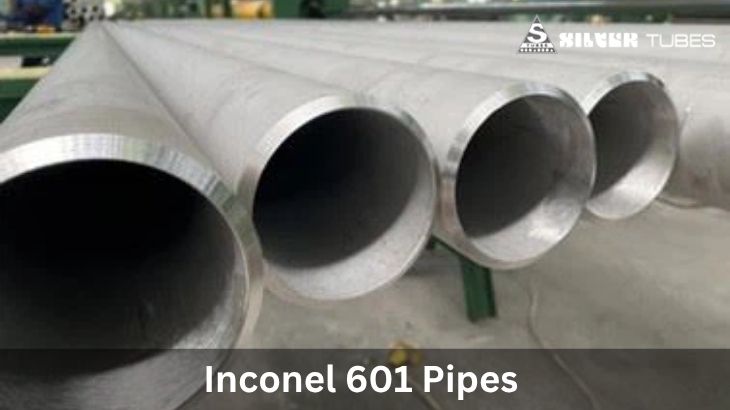
Inconel Alloy 601 Pipes are a nickel-chromium alloy designed to resist heat, oxidation, and specific corrosive conditions that can degrade lesser materials within months. Chemical processing plants operate under extreme conditions in manufacturing: corrosive chemicals corrode pipe walls, temperatures exceed the limits of carbon steel, and oxidising atmospheres accelerate surface scaling. Standard stainless steel corrodes or scales depending on the combination of conditions.
What Are Inconel Alloy 601 Pipes?
Inconel Alloy 601 is a nickel-chromium alloy with an aluminium addition, developed for resistance to oxidation at high temperatures. The UNS designation N06601 identifies the grade on datasheets and mill certificates. Nickel at 58 to 63 percent forms the base, chromium at 21 to 25 percent forms the oxide layer, and aluminium at 1.0 to 1.7 percent strengthens that film, with iron making up the balance.
Pipe supply is a welded and seamless construction, produced to standards such as ASTM B167 for pipe and tube and ASTM B366 for fittings, with diameter, wall thickness and length determined by the project’s engineering drawings.
Key Properties of Alloy 601 Pipes
Alloy 601 pipes bring six properties relevant to chemical processing service: oxidation resistance in continuous service to around 1204 degrees Celsius (2200 degrees Fahrenheit) without heavy scaling, resistance to a range of corrosive media such as mineral acids and sodium hydroxide at moderate concentrations and good mechanical strength that helps pipe walls support near-furnace piping runs. The list continues with carburization resistance under suitable atmospheric conditions, metallurgical stability across thermal cycling and welding characteristics that permit SMAW, GMAW, GTAW and SAW processes without preheat or post-weld heat treatment. Actual performance still depends on chemical concentration, temperature, pressure, flow and exposure time, so real process testing matters more than published values.
Benefits of Inconel 601 Pipes in Chemical Processing
Reliability under sustained heat and chemical exposure is the core benefit. Inconel 601 pipes are brought to a processing line. Where carbon steel scales and thins within a single operating season, Alloy 601 maintains a stable oxide layer that holds wall thickness for years, cutting unplanned shutdowns for pipe replacement.
Corrosion resistance across selected media provides additional protection for systems handling mineral acids or caustic solutions, as covered in our guide to Corrosion Resistant Inconel 601 Pipes. Thermal stability at elevated temperatures reduces the risk of creep or premature failure in piping that runs hot for long periods, and structural reliability holds when engineers specify the grade accurately, cutting total cost of ownership even when the material itself costs more than standard stainless steel.
Applications of Inconel 601 Pipes in Chemical Processing
Chemical processing equipment exposed to combined heat and corrosive damage generates substantial demand for Inconel 601 pipes. Process piping that carries hot gases or corrosive fluids between reactor vessels relies on the alloy’s stability at operating temperature. Heat treatment and thermal processing systems use it in furnace piping, radiant tubes and muffle components, where oxidation resistance extends service life.
Furnaces and high-temperature processing equipment draw on the same properties as equipment used in chlorination processes once engineers confirm compatibility. Petrochemical and chemical handling systems, exhaust systems, process gas lines and components exposed to highly corrosive atmospheres include common uses. Suitability depends on the exact process chemistry and operating conditions for each system.
Factors to Consider When Selecting UNS N06601 Pipes
Pipe size and wall thickness are prioritized when specifying UNS N06601, since both determine flow capacity and pressure rating for the service. Seamless construction suits high-pressure or highly corrosive lines, while welded pipe meets requirements at a lower cost for less demanding sections.
Applicable ASTM and ASME specifications, such as ASTM B167 and ASME SB167, confirm the material meets recognised standards, while operating temperature, pressure and chemical environment determine which corrosion mechanisms apply. Fabrication requirements such as welding procedure qualification, along with inspection needs like radiography or hydrostatic testing, round out the checklist. Sourcing from an established Inconel 601 Pipes Supplier with mill certification reduces the risk of receiving mismatched material, since selection should rely on actual process conditions.
Conclusion
Inconel 601 pipes earn their place in demanding chemical processing environments by combining oxidation resistance, corrosion resistance across selected media and mechanical strength at elevated temperatures. Plants running hot process lines, furnace piping, or corrosive gas systems gain measurable service life over standard stainless steel, provided the correct pipe specification and grade match the application’s actual operating conditions.