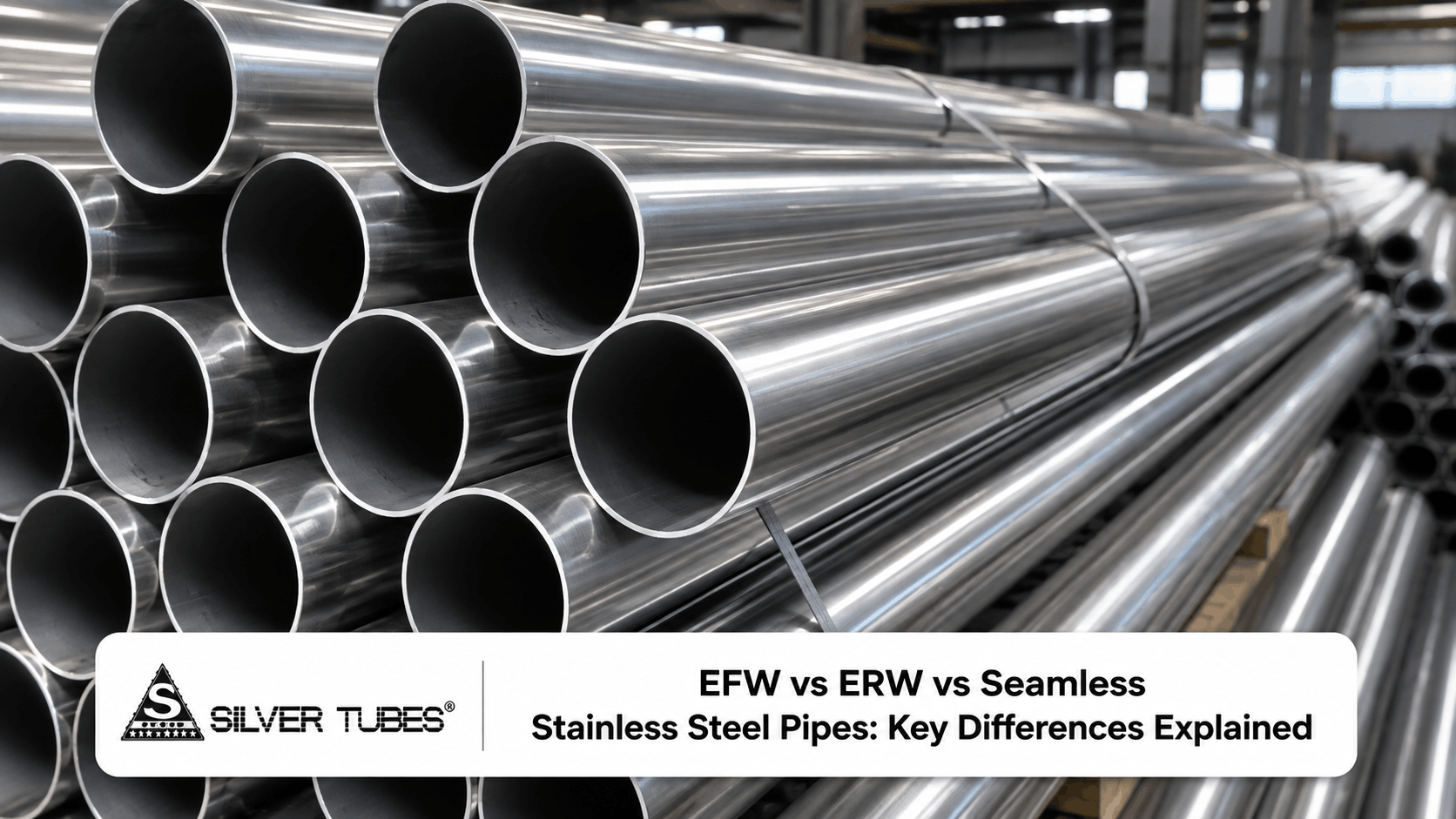


Seamless stainless steel pipe and welded stainless steel pipe are the two main types used in industries nowadays. Both are highly corrosion-resistant, durable, and strong, but they are different with their designs and performance. Seamless pipes are pressure-resistant, whereas welded pipes are cost-effective and readily available. The choice between the two depends on the application: high-pressure oil and gas or low-pressure structural applications.
What are Welded Pipes?
A Stainless Steel Welded Pipe is manufactured by bending and rolling a steel plate and welding the edges, resulting in a visible seam. SS welded Pipes are cost-effective, easy to produce in large diameters, and widely applied in industries. Although SS welded pipes have adequate strength for most purposes, the weld joint is susceptible to weakness under extremely high pressure or temperature, making it weaker than seamless pipes. It is ideal for low-pressure and structural applications, including water supply, chemical transmission, support structures, and general piping. Stainless Steel Welded Pipe is often selected for its cost-effectiveness, availability, and usefulness in general applications.
What are Seamless Pipes?
A Seamless Stainless Steel Pipe is manufactured without a weld seam by piercing, extruding and rolling solid steel billets, giving it uniform strength across the entire structure. This type of SS Steel pipe is perfect for high-pressure, and high-temperature applications, making it the preferred option for industries such as oil and gas, power production, and chemical processing. While welded pipes exist in forms such as ERW (Electric Resistance Welded), LSAW (Longitudinal Submerged Arc Welded), and SSAW (Spiral Submerged Arc Welded), seamless pipes remove the risk of weld defects, though they are more costly and harder to produce in larger diameters. They are widely used in oil pipelines, gas transport, boilers, and heat exchangers where strength and safety are essential.
Difference Between Seamless and Welded Pipe Explained
Seamless, and welded pipes both serve essential purposes, but they differ due to their manufacturing processes. Seamless stainless steel pipe provides outstanding durability and pressure resistance, however welded stainless steel pipe is more affordable and available in a larger range of sizes.
Seamless and Welded Pipe Manufacturing Process
Welded Pipes
- Rolling and Bending: Steel plates or strips are rolled and bent into a cylindrical form, creating the foundation structure of the pipe. The shape ensures the pipe has the desired diameter and thickness. After rolling, the edges are accurately aligned to be ready for welding, which is pivotal in the finishing strength of the pipe.
- Welding Techniques: The edges are joined using processes like ERW (Electric Resistance Welding), EFW (Electric Fusion Welding), or SAW (Submerged Arc Welding). Each welding method provides a solid bond, though minor differences in seam quality may occur. Proper welding ensures that the pipe can handle operational pressures within its designed limits.
- Strength and Reliability: The weld joint is slightly weaker than the pipe body, but it provides enough strength for most low to medium-pressure applications. With careful inspection and quality control, welded pipes remain dependable for water supply, structural, and general industrial use. Their cost-effectiveness and availability make them a popular choice for less demanding projects.
Seamless Pipes
- Extrusion and Piercing: A steel billet is heated and pierced to form a hollow tube, with no weld seam. This establishes a uniform, uninterrupted framework, that removes any weak points. The hollow tube is then ready to undergo further rolling and shaping to obtain its desired dimensions.
- Hot rolling: The pierced billet is stretched and rolled to the desired thickness, dimension and finish. Rolling increases the pipes mechanical qualities, and creates smooth internal and external surfaces. This procedure also improves the pipe’s resistance to pressure, and stress, qualifying it for crucial applications.
- Strength and Reliability: As there are no weld seams, seamless pipes have uniform strength throughout the construction, which makes them ideal for high-pressure applications. It can withstand high pressures, temperature variations, and multiple stress cycles without losing its integrity. This makes them perfect for applications such as oil and gas, electricity generation, and chemical processing.
Effect of Process
The absence of a weld seam makes seamless pipes stronger under pressure. Welded pipes, while slightly weaker, are easier and cheaper to produce in larger diameters.
Applications & Industry Use
Seamless and welded pipes serve different sectors depending on performance needs.
Seamless Pipes :
Seamless Stainless Steel Pipe is used in applications where performance and safety cannot be sacrificed. Seamless pipes are used in oil and gas pipes as they can tolerate high pressures and temperatures without leaking. Seamless pipes work consistently under persistent stress, and heat in boilers and refineries. Seamless pipes are a preferred option for high-pressure applications due to their consistent strength and lack of flaws.
Welded Pipes :
Stainless Steel Welded Pipe is widely used in applications where cost efficiency and availability are more important than extreme strength. They are common in structural projects such as building frameworks, water supply networks and general fluid transport. Since welded pipes can be made in larger diameters and thinner walls, they are ideal for low-pressure systems. Their affordability and wide production range make them a practical solution for everyday industrial and construction needs.
Standards & Grades
ASTM standards for seamless pipes include ASTM A106, ASTM A53, and ASTM A312, while those for welded pipes include ASTM A312, ASTM A358, and ASTM A778. Common grades include stainless steel 304, 304L, 316 and 316L; carbon steel grades ASTM A106 Gr B and ASTM A53 Gr B; and alloy steel ASTM A335 (P11, P22, P91). International standards also apply, such as ASME (American), API (Petroleum Institute), DIN (German), and EN (European).
Technical Comparisons
- Strength Under Pressure: Seamless pipes can sustain higher burst pressure than welded pipes. Their homogeneous structure, devoid of weld seams, allows stress to be evenly distributed across the pipe wall. This places them in high demand for applications such as oil and gas transmission, where sudden pressure spikes are possible.
- Durability: Seamless pipes resist fatigue, and tension better. It can withstand harsh working conditions without cracking or deforming under stress. This long-term reliability reduces replacement costs and improves safety in demanding projects.
- Corrosion Resistance: Both types perform well in stainless grades, but weld seams may need extra inspection. If not treated properly, welded surfaces can be more susceptible to localized corrosion. Seamless pipes which have no welded seams, it provide a smoother surface, that reduces the weak points
- Performance Factors:
- Strength: Seamless has higher tensile and yield strength. This enables them to withstand more weight and operate better in harsh operating environments. Their consistent structure gives them an advantage in strength-critical applications.
- Pressure Resistance: Seamless pipes perform better, than welded pipes in high pressure applications. Their solid wall construction prevents leakage or rupture under intense operating conditions. This reliability makes them vital in industries such as petrochemicals, power plants, and refineries.
- Fatigue Resistance: Seamless lasts longer under repeated stress cycles. They can endure constant vibrations, and thermal changes without losing structural integrity. This makes them a dependable solution for long term service in dynamic environments.
Cost & Availability
Seamless Stainless Steel Pipe is more expensive due to its complicated production process, whereas Stainless Steel Welded Pipe is affordable, and ideal for cost-saving projects. Welded pipes are available in large diameters and thin walls, while seamless pipes are restricted in size but provided in high-strength grades. Silver Tubes delivers seamless stainless steel pipes as well as stainless steel welded pipes at discounted prices with ample stock availability, and quick global delivery.
Buying & Quality Guide
When selecting pipes, consider the pressure rating, temperature, and industry norms. Always check for ASTM or comparable certification.
Silver Tubes is a reliable supplier of both seamless and welded stainless steel pipes. It is an ISO and API certified company, which ensures quality. With export-grade packing and a strong global distribution network we make sure that pipes are delivered in pristine shape and ready to use.